by Camillo Giamundo and Leonardo Muradian Cundari
Since 12/30/23, the Procurement Law (Law 14,133/21) has unified older rules. A highlight is the innovation in the qualification phase, covering legal, technical, tax, social, labor and economic-financial qualification.
Since December 30, 2023, the new Procurement Law (Law 14,133/21) has exclusively governed all matters covered by the former rules set out in the old Law 8,666/93, the Reverse Auction Law (Law 10,520/02) and part of the Differentiated Public Procurement Regime Law (arts. 1 to 47-A of Law 12,462/11).
One of the greatest concerns of companies taking part in tenders lies in the new Procurement Law’s innovation regarding the qualification phase of the tender process. This stage is defined by art. 62 as the phase in which the bidder must prove, through information and documents, its capacity to perform the object of the tender based on four pillars: (1) legal qualification; (2) technical qualification; (3) tax, social and labor qualification; and (4) economic-financial qualification.
Compared to Law 8,666/93, the new Procurement Law introduced minor changes, both structural and substantive.
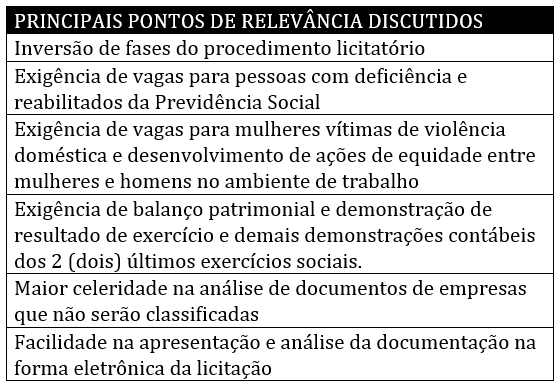
As for structural changes, what was the exception under the old law will now be the rule: the inversion of the phases of the tender procedure. Unlike Law 8,666, the general rule of article 17 of the new law provides that commercial proposals and bids will be submitted and evaluated first, followed by the analysis and verification of bidders’ qualification. Although the law allows the qualification phase to precede these other phases by means of a provision in the tender notice, this will be exceptional (art. 17, §1), requiring proof of the benefits arising from this “inversion of the inversion”.
In addition to this structural change, it can be noted that Section II of Chapter II (“Qualification”) had its requirements expanded. An important example is the requirement of positions for persons with disabilities and those rehabilitated by Social Security. This reservation, which under the old law was only a tiebreaker criterion, has now been incorporated into the new law as a mandatory qualification criterion.
However, such requirements apply to specific situations; for example, the reservation of positions for persons with disabilities and rehabilitated workers will be required of companies with 100 or more employees, ranging from 2% to 5% of positions allocated to this group, increasing or decreasing according to headcount, as provided in specific legislation (Law 8,213/91). Consequently, companies whose workforce does not reach the minimum number will not be required to prove compliance with this requirement.
In addition, the new Procurement Law was recently regulated to require actions benefiting women and gender equality. Decree 11,430/23, signed on International Women’s Day and incorporated into the new Procurement Law, provides for the requirement, in public contracts, of a minimum percentage of the workforce made up of women victims of domestic violence, and for the bidder’s development of gender equity actions in the workplace as a tiebreaker criterion in tenders. Although it is not a mandatory qualification requirement, evidence of these practices will be taken into account in tiebreaks as a positive differentiator and, therefore, for ranking purposes.
The above provision, in turn, applies to contracts for continuous services with dedicated labor, requiring a minimum of 8% of positions to be reserved for this group.
Another relevant point concerns economic-financial qualification under the new law. Bidders are now required to submit a balance sheet, income statement and other financial statements for the last two fiscal years.
It can therefore be seen that the legislator incorporated both social demands and more specific and detailed requirements regarding bidders’ capacity. The reason for this approach can be seen as a positive consequence of the inversion of phases: since the analysis of documents will take place after the commercial proposal and evaluation phases, fewer bidders will reach this phase and, therefore, document verification can be more exhaustive, detailed and in-depth with respect to the companies, without slowing down the tender procedure.
In this way, greater speed and less time spent analyzing documents of companies that, under the old law’s procedure, would not even be ranked but would still have their documents analyzed, is expected. Now only the winning bidder will move on to the qualification phase, generating procedural savings.
Furthermore, it can be considered that delays will also be reduced through the preference for electronic tenders (art. 17, §2), as this clearly speeds up and facilitates the submission of documents and their subsequent analysis by the Public Administration. In-person tenders may nevertheless be chosen, provided this is duly justified. However, the tendering Administration is expected to pay attention to the security of the electronic system and to the document protection structure provided to bidders, avoiding weaknesses, doubts or room for fraud or improper access to documents by third parties, which would breach the confidentiality of the procedure.
Finally, nothing is more instructive and conclusive than a table with the main changes arising from the topic discussed, also pointing out the possible advantages and disadvantages that can be inferred from the new qualification rules of the new Procurement Law:
Article originally published on the Migalhas website (in Portuguese), on 01/31/2024