

Last year, 125 tenders were canceled and another 114 projects were suspended or postponed, according to Radar PPP
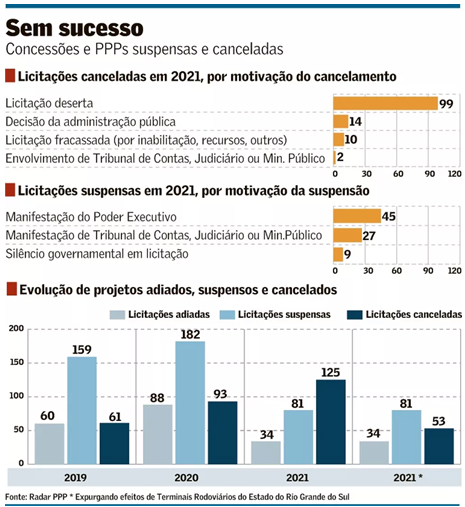
Concession and Public-Private Partnership (PPP) projects, increasingly widespread in the country, still face a high failure rate. Last year, 125 tenders (with notices already published) were canceled, a 20% increase over the previous year. In addition, another 114 initiatives were suspended or postponed during the year, according to a survey by consultancy Radar PPP.
The situation has improved as the model has matured in the country. However, the numbers are still considered high. The assessment is that governments still struggle to prioritize and draft good tender notices, in addition to the adverse economic scenario, experts say.
The total number of cancellations in 2021 was inflated by a flood of tenders for bus terminals in Rio Grande do Sul. The assets were offered individually rather than in blocks — a model that proved unsuccessful. Excluding these projects, the number of projects terminated during the year falls from 125 to 53, below the figures for 2020 and 2019, when 93 and 61 tenders were canceled, respectively.
For Frederico Ribeiro, partner at Radar PPP, there has been progress in structuring tender notices. “The market has matured and has been able to absorb best practices. Today, there are a number of benchmark projects, which helps avoid mistakes”, he says. Even so, he considers the failure rate to be high.
On a monthly average in 2021, for every 4 tenders under way, 1 was canceled, suspended or postponed. Excluding the bus terminal projects in Rio Grande do Sul, the ratio falls to 1 failed project for every 5 under way.
The high failure rate of concessions is nothing new and has always been closely associated with legal disputes and interventions by oversight bodies, such as the Public Prosecutor’s Office and courts of accounts. Last year, however, the main reason for failure was the lack of private interest in the assets, which led to tenders with no bidders.
The rising interest rate scenario has hurt the attractiveness of concessions, says Luis Eduardo Serra Netto, partner at Duarte Garcia Advogados. “Many investors are moving to fixed income, and financing costs are higher. You can see this impact on all projects. Making auctions attractive becomes more difficult, and many end up being shelved or die.”
For Sandro Cabral, professor of Strategy and Public Management at Insper, both the public and private sectors have learned a lot in recent years and improved the structuring of tender notices. However, he believes that the current economic crisis and scenario of instability are dampening investor interest. “An institutional environment that inspires confidence is needed; this must go hand in hand with capacity building”, he says.
In addition to the bus terminals in Rio Grande do Sul, there are other examples of tenders that received no bids. One of the largest cases is the auction for the electronic ticketing system for public transportation in Rio de Janeiro, which was the target of several challenges and managed to go ahead, but ended without any bids. Another case identified by Radar PPP was the concession of the Blumenau Public Market (SC), whose auction also attracted no interested parties.
One of the main problems with concession failures is the waste of public and private effort on a project that does not go ahead, analysts point out. For Sandro Cabral, it is important for governments to be more selective in their initiatives.
Luiz Felipe Graziano, partner at Giamundo Neto Advogados, believes the ideal is to set up specific units along the lines of the federal government’s Investment Partnerships Program (PPI) — a format that has been replicated in subnational entities and, according to him, has produced results.
“This structure helps ensure continuity of the portfolio even when administrations change and to filter which projects best fit the planning. The risk of failure is setting an entire machine in motion for initiatives that later prove not very relevant. It is important to optimize resources and define clear criteria for selecting projects.”
At the municipal level, technical difficulty is still the major obstacle, says Ribeiro, of Radar PPP. “It is almost a cliché, but public sector capacity remains one of the biggest bottlenecks. Investment in this is needed. Administrations do not necessarily have to prepare the study, because there are tools such as the PMI [Expression of Interest Procedure] for that, but they need to develop the capacity to at least evaluate the project.”
In the view of Rosane Menezes, partner at Madrona Advogados, this difficulty has improved greatly over the last three years, during which public institutions such as Caixa and BNDES have provided more support for structuring municipal and state projects, which has been reflected in better-quality tender notices. “Another bottleneck is project guarantees, which has also been advancing. I have a positive view and believe this market will continue to advance”, she says.
Story originally published on 01.31.2022, by Taís Hirata, in Valor Econômico (in Portuguese).

