

by Diogo Albaneze Gomes Ribeiro
On 05.07.20, Provisional Measure No. 961/2020 (“MP 961”) was published, authorizing the public administration of all federative entities, all Branches and constitutionally autonomous bodies to make advance payments in tenders and contracts.
In addition, MP 961 adjusts the thresholds for waiver of tender and broadens the use of the Differentiated Public Procurement Regime (RDC) to tenders and contracts for any works, services, purchases, disposals and leases.
This Provisional Measure applies exclusively to acts and contracts entered into during the state of calamity recognized by Legislative Decree No. 6 of March 20, 2020.
In short, the amounts allowed for contracts entered into with a waiver of tender for engineering works and services, as well as for other services and purchases, have been significantly increased, as shown in the table below.
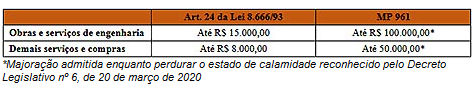
The aim is not only to facilitate but also to speed up contracts that are essential to maintaining indispensable services. Indeed, the limits imposed by Law 8,666/93 may not be suitable for the extraordinary moment we are experiencing.
The increase in the threshold for waiver of tender, however, must not become a kind of subterfuge for entering into inappropriate or disadvantageous contracts for the Public Administration. The basic principles guiding administrative action must also be observed in direct contracting.
It follows that the absence of a tender does not authorize the Administration to contract with whomever it pleases, without the necessary precautions and documentation. Direct contracting also requires a prior administrative procedure, in which compliance with stages and formalities is essential — such as: (i) verifying and demonstrating the need to be met, (ii) the most appropriate means of meeting that need, (iii) the correct definition of the object to be contracted, as well as (iv) a prior assessment of the market price of the products/services to be contracted.[1]
Therefore, even if there is no formal tender, certain internal procedures must be followed to demonstrate the regularity of the contract.
Another relevant aspect of MP 961 is the provision for advance payment by the Administration in tenders and contracts, provided that it: (i) is an indispensable condition for obtaining the good or ensuring the provision of the service; or (ii) results in significant savings.
This is an interesting provision which, if well managed,[2] could bring significant savings to the Government. After all, it is common knowledge that one of the major problems related to public procurement stems from the risk of default by the contracting body — a risk that is invariably priced in by private parties.
Therefore, enabling advance payment for certain services and works may bring significant price advantages, as well as making these contracts much more attractive to many companies — especially at this time of economic standstill.
Finally, MP 961 enabled the use of the Differentiated Public Procurement Regime (RDC) for tenders and contracts for any works, services, purchases, disposals and leases.
The expansion of the cases in which the RDC may be used is, in a way, a rehearsal for what is to come, considering that the Bill aimed at amending the Public Procurement and Administrative Contracts Law incorporates several rules currently found in the RDC Law.
The use of the RDC will certainly bring some advantages, as it allows, among many other aspects: (i) the tender to be held electronically; (ii) the inversion of phases in the evaluation of bids; (iii) negotiation of more advantageous conditions with the first-ranked bidder; and (iv) contracting works with only a preliminary engineering design, without a basic design (integrated contracting system).
In short, MP 961 has virtues which, if properly applied, may bring efficiency and advantageousness to public procurement.
[1] JUSTEN FILHO, Marçal. Comentários à Lei de Licitações e Contratos Administrativos. 16th edition. São Paulo: RT, p. 390-391, 2014.
[2] Especially if the precautions provided for in § 2 of art. 1 of MP 961 are observed, which may include (i) proof that the contractor has performed part or an initial stage of the object, for the advance payment of the remaining amount; (ii) provision of a guarantee in the forms set out in art. 56 of Law 8,666/93, of up to thirty percent of the value of the object; (iii) issuance of a credit instrument by the contractor; (iv) monitoring of the goods, at any time during transport, by a representative of the Administration; and (v) requiring certification of the product or supplier.
Article originally published on Portal Fator Brasil (in Portuguese), on 05.08.2020.

