

Infrastructure. Market expectations are positive for the federal government’s upcoming auctions, but experts warn of uncertainty in sectors with an outdated regulatory framework
03/10/2017 – 05h00
São Paulo – The market is optimistic about the federal government’s upcoming concessions, especially in infrastructure. However, experts point out that consolidating each sector’s specific regulatory framework is necessary to ensure continuity and legal certainty for companies.
According to Bruno Feigelson, partner at Lima Feigelson Advogados, the lack of a settled regulatory framework still hinders the success of concessions in some sectors. “In railways, for example, the idea was to strengthen Valec, in a model in which the government would buy the railways’ idle capacity as a way of guaranteeing demand for the concessionaire”, the attorney recalls. “However, the Federal Court of Accounts held that a new regulatory framework was needed to do this. As a result, we saw neither the new regulation nor railway concession projects”, he says.
For Feigelson, the idea of building railways to stimulate cargo demand, generating revenue during construction, was a good one, but it ran into legal problems that were never resolved, which ended up harming the whole economy. “It makes no sense in a country of continental proportions like Brazil for highways to carry 52% of cargo. And [the country] has still not managed to attract the private sector to build the railway network”, says the attorney.
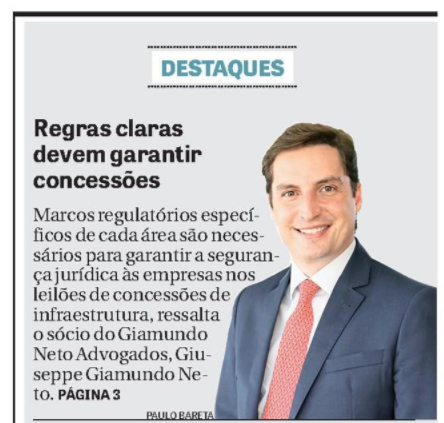
In other sectors, however, experts see progress that has increased investor interest in Brazilian assets. Giuseppe Giamundo Neto, founding partner of Giamundo Neto Advogados, praises the success of the concessions for the airports of Porto Alegre (RS), Salvador (BA), Florianópolis (SC) and Fortaleza (CE). “Specifically for the latest concession, the government removed Infraero’s [Brazilian Airport Infrastructure Company] mandatory stake of almost 50% in the operation. In addition, operators were sought, not just builders. That is why major international concessionaires were interested”, the specialist says.
Bruno Feigelson comments that the discussions to definitively remove Infraero’s obligation to participate in all concessions under the aviation regulatory framework show a concern to reduce state intervention in projects, giving private companies more freedom.
Changes are also planned for other sectors such as oil and mining, all following the change to the ports regulatory framework in 2013, which was considered positive. “The concessions that have been working are those for ports, since the approval of Law 12,815/2013. In that case, the need for regulatory stability was met”, he comments.
In Giamundo Neto’s view, past concessions had many mistakes, such as poor-quality economic and operational studies for the project, unclear rules on economic and financial balance, and guarantees that were not very effective in cases where the government failed to comply with the rules.
“Foreign companies often see that a project makes sense, but when they look at this whole framework they do not feel comfortable investing”, the attorney stresses.
Mistakes
Giamundo Neto explains that common problems in past concessions include the government’s failure to pay its share of the financial contributions in Public-Private Partnerships (PPPs) and failure to obtain the licenses needed to carry out the concession. “If the government does not do its part in obtaining environmental and urban planning licenses, this seriously harms the project. Expropriation itself is often the public sector’s responsibility, which has a sharp impact on the concession if it is delayed”, he adds.
In such cases of non-compliance, companies can turn to an arbitral tribunal to resolve the dispute, since most concession contracts provide for arbitration, rather than the courts, for any disputes. “This is beneficial, because arbitration is resolved more quickly. It takes, on average, two years — not a decade, as in the courts.”
However, Giamundo Neto stresses that some projects are so poorly structured that not even arbitration can solve the problems. “What is not a disposable right is outside arbitration. So the contract must be terminated and a new concession awarded.”
Precautions
Pablo Sorj, partner at Mattos Filho Advogados, notes that companies need to read concession tender notices carefully, conducting studies to determine whether it is worth bidding for a project. “When a company goes to auction, there is demand risk. And it can only protect itself when the government guarantees minimum demand”, he explains.
For those who want to become concessionaires of a public service but want to stay away from risk, Sorj recommends favoring concessions for shorter stretches with guaranteed minimum demand. “Many of the concessions handed back in the past were for airports larger than necessary given demand, or highways where traffic was not as heavy as forecast.”
The Mattos Filho partner also notes that many of the problems in past concessions reflected a macroeconomic scenario that will not be as strong today. “In highways, there was a very significant economic impact, with rising raw material costs and the recession”, he concludes.
Ricardo Bomfim

